Day Light Songs (biting the air)
- Permanent installation
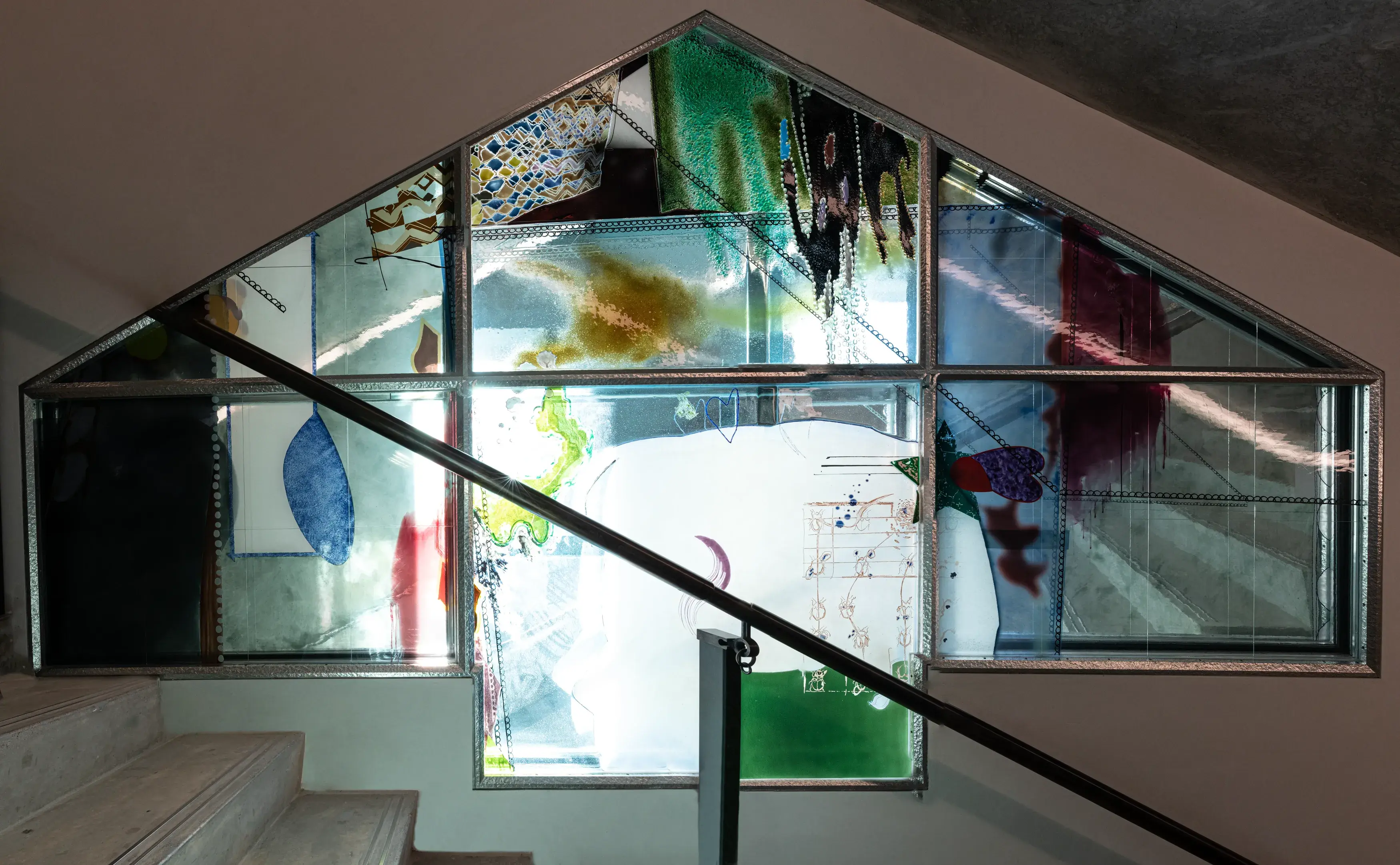
Day Light Songs (biting the air) is a site-specific installation for three of the publicly accessible and daily used sections of the security staircase of The Tower. Comprising layered glass works and aluminium frames, it is occupying 3 double-sided apertures. Day Light Songs (biting the air) is neither painting nor stained-glass window, but a hybrid of the two. Produced as acts of literal liquid alchemy, the process included multiple ancient and contemporary techniques, such as, acid etching, fusing, enamelling, sand blasting, silver staining, silk screening and hand painting.
The profile of a child’s head dominates, sitting both centrally and at rising or sinking points around the aluminium frames. Within the silhouette is the word ‘mama’. The child’s central head becomes part of an alphabet, a shape that might be representative of a series of spoken sounds, or single letters from which a set of actions can unfold. These views shift, depending on whether the viewer is climbing or descending the doubled-sided staircase. A series of graphic vector forms, interposed between several sets of fences can just as equally be signs or diagrams or they can be portraits. Suspended, this morphing system of vantage points and characters, mixes with the textures of glass and milled metal details to add more units of measure, each relentlessly collaged into one another. This series of hybrid forms is deviced to morph and flex with incoming light. It becomes a quiet parable of the exponential powers of the universe to shrink and expand before us, a complex mathematical equation of many interconnected pieces.
Helen Marten
Helen Marten studied at Central Saint Martins, University of the Arts, London and Ruskin School of Fine Art, University of Oxford (2005-2008). In 2016 she was awarded the Turner Prize. Marten works across sculpture, painting, video and writing to create a body of work that questions the stability of the material world and our place within it. Alluding to ideas, systems and experiences, her work across all media sets out to articulate complex ideas about the way in which we exist in and understand the world around us. Marten assigns central importance to physical reality and craftsmanship. In her selection of materials she explores the questions as to how expectation translate into material language - how material could be used for its specific location for a new narrative, or which materials can be associated with which characteristics, and, correspondingly, already “belong” to a fixed set of associations.