Now showing at LUMA Arles: David Armstrong, Liu Chuang, Maria Lassnig, Philippe Parreno, and Tony Oursler


/Pages%20%C3%A9dito/Espaces%20en%20acc%C3%A8s%20libre/220522-LUMA-PARCPAYSAGER-REMIBENALI-053%20-%201920%20x%201280.webp)
Crédits
Des visiteurs se promènent dans le parc paysager.
© Rémi Benali
Free-access spaces
At LUMA Arles, art and architecture can also be experienced free of charge.
Beyond the temporary exhibitions, a large part of the Parc des Ateliers is open to the public: The Tower, with its panoramic terraces and slides, as well as the landscaped park and its phosphorescent skate park.
Inside The Tower
The Tower is the iconic gateway to the Parc des Ateliers. Open to all without a ticket, it features permanent spaces and artworks to discover as you move through its different levels.
Inside, you will find:
Ground level
-
Two video pods: two videos by Maja Hoffmann and Frank Gehry introducing the LUMA Arles project.
-
Drum Café: A café conceived as a work of art by Rirkrit Tiravanija and Atelier LUMA.
Learn more about the Drum Café
One of the key artists in the history of relational aesthetics, Tiravanija has designed and created one of the bars, located on the ground floor area of The Tower designed by Frank Gehry. The bar is designed as a lived-in artwork and includes the use of a huge array of material. Walls in stainless steel with exposed pipes and panels made from sunflower marrow: this restaurant and bar transforms the notion of hospitality with its very strong visual identity. Conviviality and sharing lies at the heart of Tiravanija’s practice and the bar and restaurant inevitably becomes one of the crucial representations of time spent with others.
The design is utilizing materials of the bioregion of the Camargue and natural resources, such as sunflower pulp, local wool, natural pigments and fabric dyes. A 10-metre long monumental tapestry created with artisans in Aubusson factory, central France, is the landmark of the space. It was made over many years and has used unique tapestry techniques and materials, in collaboration with designers and researchers from the labs of Atelier LUMA.
Level 1
-
Dans la forêt : a monumental ceramic wall mural by Etel Adnan.
Learn more about the mural
Etel Adnan has created a unique artwork in the medium of ceramic wall mural covering the entire back wall of the auditorium at LUMA Arles. The mural is based on four of her drawings that represent the movement of trees in the wind, made in her trademark vibrant colours of orange, yellow, green and blue. These colours are characteristic of her late work using marker pen on paper.
Once the drawings were created, they have been reproduced in fired ceramic tiles and enlarged to cover a wall measuring approximately 14 metres in length and 4 metres in height. The drawings are specifically made for Arles and relate to both the impression of the wind in the South and to paintings of Van Gogh, who was also inspired by movement in nature, something he extensively represented throughout his life and work. -
First panoramic terrace: offering views over the landscaped park and the skate park.
Level 2
-
Isometric Slides: two 12-meter-high slides created by Carsten Höller.
Learn more about the slides
Carsten Höller has installed a new iteration of Slides, an experimental project he has been producing in different locations for a number of years. The artist is taking advantage of the height of the space to expand on the hypothesis he has been investigating for some time concerning the possible effects of sliding. His work, playful and evocative, questions what would be the effect and result of sliding if it was part of the daily routine. It asks whether slides, which are mostly associated with playgrounds, can become part of our experiential and architectural life. He has noted that "A slide is a sculpture that you can travel inside".
However, it would be a mistake to think that you have to use the slide to make sense of it. From an architectural and practical perspective, the slides are one of the building’s means of transporting people, equivalent to the escalators, lifts or stairs. Slides deliver people quickly, safely and elegantly to their destinations, they’re inexpensive to construct and energy-efficient. They’re also a device for experiencing an emotional state that is a unique condition, somewhere between delight and madness. It was described in the fifties by the French writer Roger Caillois as "a kind of voluptuous panic upon an otherwise lucid mind." -
Take Your Time: a large circular mirror by Ólafur Elíasson, installed at the top of the double-helix staircase.
Learn more about the mirror
Take your Time is a large circular mirror fixed to the ceiling at an angle. The mirror rotates slowly on its axis, which creates a whirling sensation, destabilizing the viewer’s perception of space. The artwork is installed above the monumental, double-helix staircase, a position which adds a playful albeit disorienting effect as one arrives at its highest point. Engaging with the viewer’s movement, but also with light, reflection, and the elements of architecture and surrounding space, this work offers an enchanting experience. It is a new interpretation specifically created for the site of LUMA Arles.
-
Laguna Gloria: an immersive soundscape by Liam Gillick.
Learn more about the work
Liam Gillick has designed the communal area in level 2 of The Tower. Using film stills from his 2013 film Margin Time 2 (The Heavenly Lagoon), he has created an audio-visual landscape and a space which will be used for multiple activities. The film stills present grainy images of plants and natural environments and the idea is to create a room that resembles an artificial garden. Playing with the idea of nature as a given, and space as an agent in the production of realities, the installation becomes an inverted pavilion, centrally located within The Tower where the public and audiences can rest or transit. The notion of impermanence and artificiality are the key components of the work, which is a system of images and sounds that is made to evoke a both distant and close relationship to nature.
/Pages%20%C3%A9dito/Espaces%20en%20acc%C3%A8s%20libre/210619-LUMA-OUVERTURE-ADRIANDEWEERDT-124%20-%201280%20x%201920.webp?width=1280&height=1920&name=210619-LUMA-OUVERTURE-ADRIANDEWEERDT-124%20-%201280%20x%201920.webp "210619-LUMA-OUVERTURE-ADRIANDEWEERDT-124 - 1280 x 1920")
Isometric Slides by Carsten Höller: two monumental 12-meter-high slides, offering a thrilling experience for visitors of all ages.
Photo: © Adrian Deweerdt
Level 3
-
The Library is on Fire: an experimental library, a unique space for research and reading
Learn more about this space
A creature is looking for the form of its intelligence. Since 2011 an experimental library elaborates itself through readings of its volumes: books, films, video games, discs. It detects in them the movements, operations and structures that eventually compose the logics of its progression. As in a mysterious poem, you enter the possibility of a world where everything becomes suspense, refraction of signs, thought images, virtual source of attention.
Levels 7 to 9
-
Day Light Songs (biting the air): a work between painting and stained glass by Helen Marten, integrated into the stairwell
Learn more about the work
Day Light Songs (biting the air) is a site-specific installation for three of the publicly accessible and daily used sections of the security staircase of The Tower. Comprising layered glass works and aluminium frames, it is occupying 3 double-sided apertures. Day Light Songs (biting the air) is neither painting nor stained-glass window, but a hybrid of the two. Produced as acts of literal liquid alchemy, the process included multiple ancient and contemporary techniques, such as, acid etching, fusing, enamelling, sand blasting, silver staining, silk screening and hand painting.
The profile of a child’s head dominates, sitting both centrally and at rising or sinking points around the aluminium frames. Within the silhouette is the word ‘mama’. The child’s central head becomes part of an alphabet, a shape that might be representative of a series of spoken sounds, or single letters from which a set of actions can unfold. These views shift, depending on whether the viewer is climbing or descending the doubled-sided staircase. A series of graphic vector forms, interposed between several sets of fences can just as equally be signs or diagrams or they can be portraits. Suspended, this morphing system of vantage points and characters, mixes with the textures of glass and milled metal details to add more units of measure, each relentlessly collaged into one another. This series of hybrid forms is deviced to morph and flex with incoming light. It becomes a quiet parable of the exponential powers of the universe to shrink and expand before us, a complex mathematical equation of many interconnected pieces.
Levels 7 to 9
-
Panoramic terraces: a unique view over Arles, the Camargue, and the Alpilles
-
Open Space: a space conceived as an extension of the street, by Konstantin Grcic
Learn more about this space
This unique space for multipurpose usage, devised as an extension of the street, was designed by German industrial designer Konstantin Grcic, renowned for his radical and minimalist interpretations of everyday objects.
The two floors - 8th is an interior space and 9th is leading to the Viewing Terrace - are conceptually connected and the design follows seamlessly between the two. Grcic has created a theatrical space, using metal curtains and special lights to subdivide areas.
Reflecting on a street-like concept, the designer has created spaces that are raw but hospitable with a sensitivity to the industrial nature of the building and its metal surfaces. The two floors benefit of the most commanding views extending towards the Camargue and the Alpilles, taking in the entire city of Arles, and offering perspectives never seen before of the historical city, the surrounding nature, and the landscape.
Practical tips to make the most of your visit:
- Pick up a free site map at the information desk—it will help you find your way around the Parc des Ateliers.
- If you’re visiting with children, a free activity booklet is available on Level 0 of The Tower. Don’t forget a pencil.
- Download the LUMA Arles app—it's free and offers guided tours to enrich your visit.
/Pages%20%C3%A9dito/Espaces%20en%20acc%C3%A8s%20libre/210921-LUMA-OPENSPACE-JONATHANMAULOUBIER-24%20-%201280%20x%201919.webp "210921-LUMA-OPENSPACE-JONATHANMAULOUBIER-24 - 1280 x 1919")
The Open Space by artist Konstantin Grcic offers unique views over Arles and its surrounding landscape.
Photo: © Jonathan Mauloubier
In the landscaped park
The park’s four hectares are open to the public free of charge. Designed as a place to stroll and unwind, it is also an artistic space in its own right.
Outdoors, you will discover:
-
OooOoO: a phosphorescent skate park designed by artist KOO JEONG A
Learn more about the skate park
Korean artist Koo Jeong-A has created a glow in the dark full scale skatepark, which is installed on the public terrace adjacent to The Tower. The skating bowls are painted with fluorescent paint that illuminates the entire structure at night, creating different light conditions. The work is based on the idea of play and performativity and essential elements of contemporary culture, and the skatepark is an evidence of what it means to play with a specific intention and very real skills. Skating is also a choreography in space, with its own speed and movements. Skaters’ bodies achieve remarkable positions of balance, endeavour and endurance and are offering radical new perspectives in the experience of architectural space as we know it.
-
Krauses Gekröse: a monumental 13-meter-high sculpture by Franz West
Learn more about the sculpture
It is a 13-metre-high sculpture in pink, installed in the garden, between The Tower and the building of Les Forges. The sculpture has never been installed before in height, it has only been installed once in the artist’s studio on the floor. This is a piece seen for the first time as it was intended by West.
-
Seven Sliding Doors Corridor (Outdoor Version): an installation by Carsten Höller
Learn more about the installation
Seven Sliding Doors Corridor (Outdoor Version) consists of electronic sliding doors with mirrored surfaces on both sides, through which a viewer can walk in an apparently endless passage. The doors are installed inside a reflective corridor spanning the pond in the park. Inside that space, the doors are positioned at evenly-spaced intervals and are connected to motion sensors that cause them to slide open when someone approaches and close shut when the person moves away. As a result, the movements of viewers alternately break and bind the visual limits of the space, which can be entered from either end of the corridor, increasing the likelihood of unexpected encounters as the doors open and close.
-
MEMORY: a monumental mosaic floor created by Kerstin Brätsch
Learn more about the mosaic
The mosaic floor of the Café du Parc is based on paintings by Kerstin Brätsch. Envisaged by the artist as monumental paitings looking towards the sky, the mosaic represents different characters often found in Brätsch‘s oil on mylar paintings. The characters here are enlarged and oversized and translated into mosaic techniques, a unique process and use in the artist’s practice. Paths between the single characters consist of a stucco marmo creature which is turned into a mosaic. Similar motifs continue in the interior space of the Café du Parc, which unify the park and the interior in a spectacular way. The forms are visually powerful and command the views from The Tower to the park.
-
Orientation Platforms: a group of sculptures by Liam Gillick
Learn more about the platforms
Liam Gillick’s Orientation Platforms are sculptures made of metal that have a dual reality. They are places to hang out at, when there is nothing else around to do, but also a place for contemplation and discussion, specifically around the sculpture itself.
They are designed to be entwined to architecture and space but feature an inherent friction between presentation and purpose, utility and aesthetics. -
Membrane: a tower-like mechanical structure designed by Philippe Parreno
Learn more about the work
A leading artist of his generation, Philippe Parreno radically rethinks the exhibition format. Working across a wide range of media—film, sculpture, performance, drawing, text—he creates singular artistic experiences that play with traditional spatial and temporal limits. Installed on the lawn of the Parc des Ateliers like an antenna, Membrane is a tower-shaped mechanical structure. It houses a cybernetic system with unusual cognitive and linguistic abilities: through dialogue with its environment, it develops a new language and a virtual voice that drifts through the park like a faint, enigmatic song.
By collecting environmental data such as temperature, humidity, wind speed, noise levels, pollution, and any ground vibration, it transforms these signals into sound and varies them over time. Poised somewhere between living organism and machine, Membrane is a hybrid entity—a responsive work that senses changes in its surroundings and attunes itself to them, reflecting the rhythms of its internal and external worlds.
The landscaped park is open every day from 7:00 a.m. to 6:30 p.m.
/Pages%20%C3%A9dito/Espaces%20en%20acc%C3%A8s%20libre/240518-LUMA-NUITDESMUSEES-VICTOR%26SIMON-GREGOIREDABLON-39.webp?width=2000&height=1333&name=240518-LUMA-NUITDESMUSEES-VICTOR%26SIMON-GREGOIREDABLON-39.webp "240518-LUMA-NUITDESMUSEES-VICTOR&SIMON-GREGOIREDABLON-39")
Set alongside The Tower, the LUMA Arles skate park has become a must-see stop for skate enthusiasts and architecture lovers alike.
Photo: © Joana Luz / Victor Picon
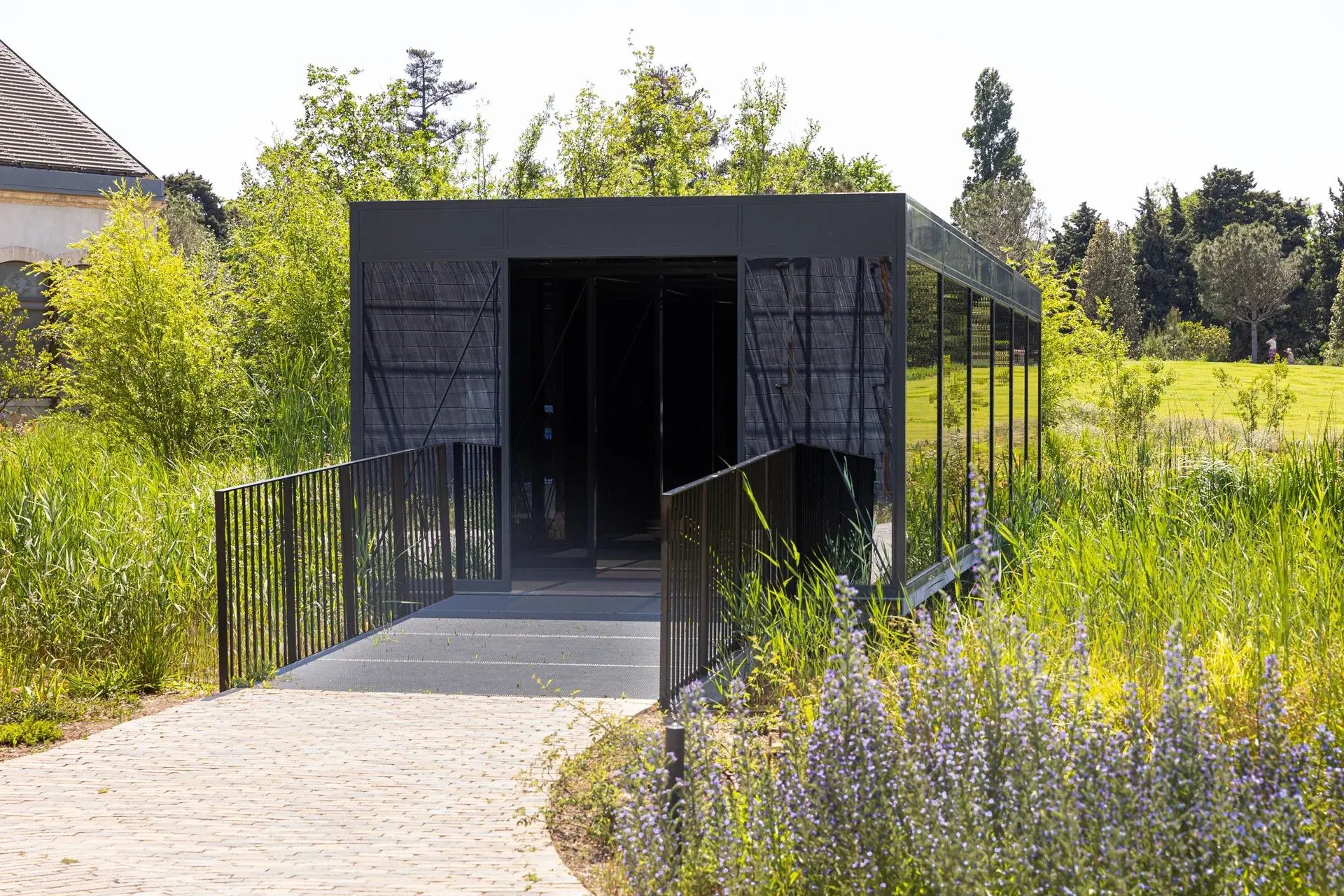
Seven Sliding Doors Corridor (Outdoor Version) by artist Carsten Höller is a corridor of seven mirrored doors installed above the park’s pond. Reacting to visitors’ movements, it creates the illusion of an endless passage and transforms the perception of space.
Photo: © Adrian Deweerdt
Free tours and workshops
On the occasion of national events such as the European Night of Museums, the European Heritage Days, the National Architecture Days, and other special moments, LUMA Arles offers free tours and workshops for all audiences.
These moments allow children and adults alike to take part in creative workshops, explore artistic themes and contemporary practices in new ways, or join guided tours highlighting current exhibitions, the site’s history, and its architecture.
/Pages%20%C3%A9dito/Espaces%20en%20acc%C3%A8s%20libre/250920-LUMA-JOURNEESDUPATRIMOINE-ADRIANDEWEERDT-1193.webp)
Credits
As part of the European Heritage Days, LUMA Arles opens its doors for tours dedicated to the history and distinctive architecture of the Parc des Ateliers.
Photo: © Adrian Deweerdt
/Pages%20%C3%A9dito/Espaces%20en%20acc%C3%A8s%20libre/240921-LUMA-PATRIMOINE-ADRIANDEWEERDT-60.webp)
Credits
Free creative workshops for children and adults alike.
© Adrian Deweerdt
Credits
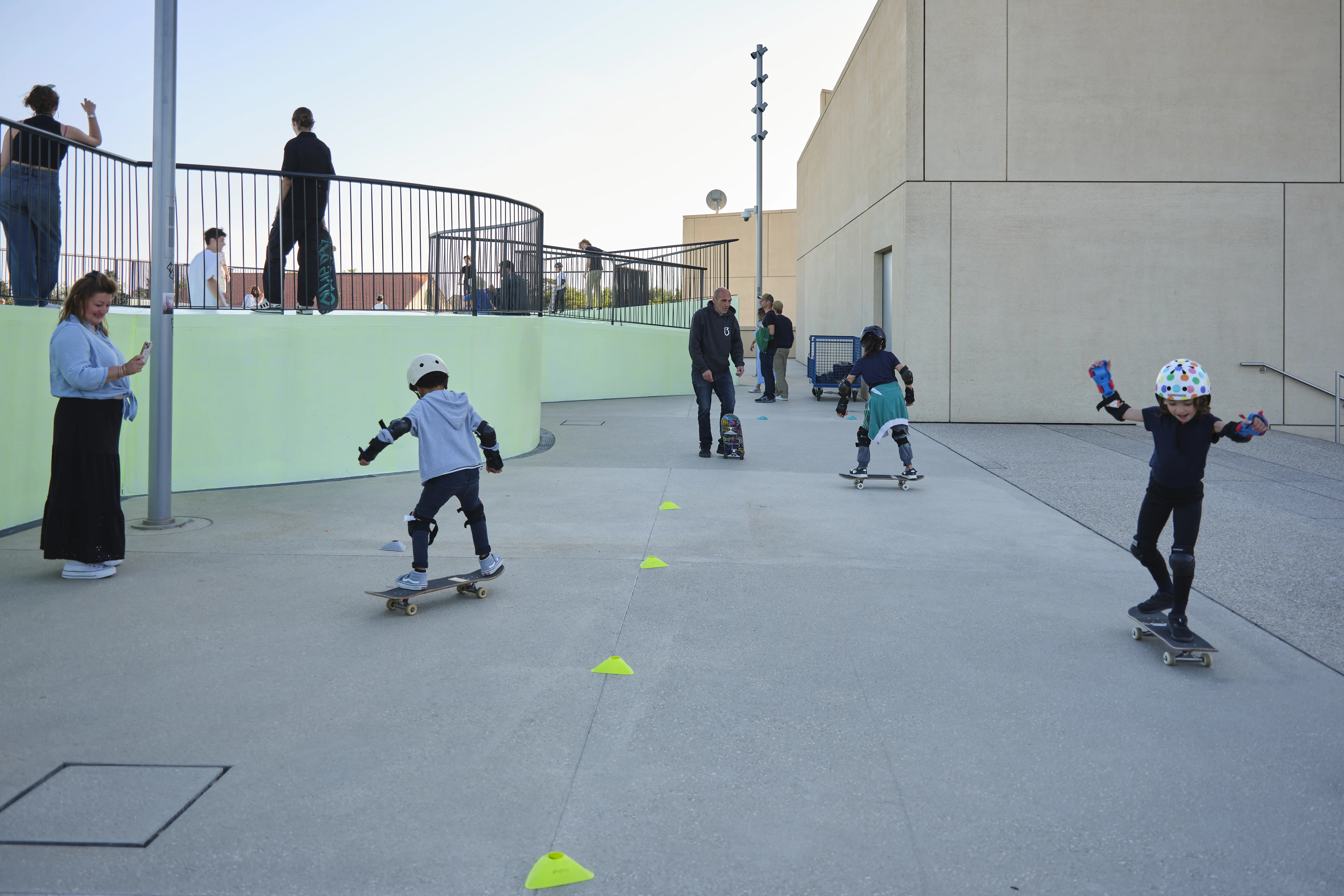
When the Olympic torch passed through Arles, LUMA Arles organized participatory workshops focused on sport and creativity.
© Victor & Simon / Grégoire d'Ablon
/Pages%20%C3%A9dito/Espaces%20en%20acc%C3%A8s%20libre/240518-LUMA-NUITDESMUSEES-VICTOR%26SIMON-GREGOIREDABLON-79-1.webp)
Credits
A must-see event, the European Night of Museums brings thousands of visitors to LUMA Arles each year.
© Victor & Simon / Grégoire d'Ablon
The Bookshop
Level –2 of The Tower
The bookshop offers a wide selection of publications on art, architecture, design, the humanities, and visual culture, along with exhibition catalogs and editions published by LUMA.
It also features a curated selection of objects, postcards, and original creations. Children are not forgotten, with a dedicated area offering books and items specially selected for them.
/Pages%20%C3%A9dito/Espaces%20en%20acc%C3%A8s%20libre/250829-LUMA-LIBRAIRIE-ADRIANDEWEERDT-403%20-%201920%20x%201280.webp "250829-LUMA-LIBRAIRIE-ADRIANDEWEERDT-403 - 1920 x 1280")
Photo: © Adrian Deweerdt
Arlésien Card: free access to the exhibitions
LUMA Arles offers Arles residents an Arlésiens Card, providing free access to all exhibitions.
This personalized annual card is issued upon presentation of proof of residence.